Every menu cover has one quiet job: hold the printed pages flat, keep them clean, and let a server swap them the day the kitchen changes a price. The part that decides how well it does that job is the binding — the corners, bands, posts, cord, or rings that attach your inserts to the cover. Two covers can look identical on the table and behave completely differently a month later, when you reprint the wine list or drop in a seasonal page. This guide walks through how to choose the attachment method before you order, so the sample you approve still works on the tenth reorder.
Start with two questions: how many pages, and how often do they change?
Nearly every binding decision comes down to page count and reprint frequency. A single-panel lunch card that changes twice a year has different needs than an eight-page wine list you revise monthly. Count the reading surfaces you actually need — a folded sheet gives you two, a stitched booklet gives you as many as you print — and be honest about how often those surfaces change. If you reprint often, prioritize a method a host can reload in seconds without tools. If the menu is stable, you can favor the cleanest look and worry less about swap speed.
The chart below shows the rough page ceiling for each common method. Treat the figures as indicative rather than exact: real capacity depends on paper weight and how thick the cover is built, so a heavy cover stock will hit the limit sooner than a light text sheet.
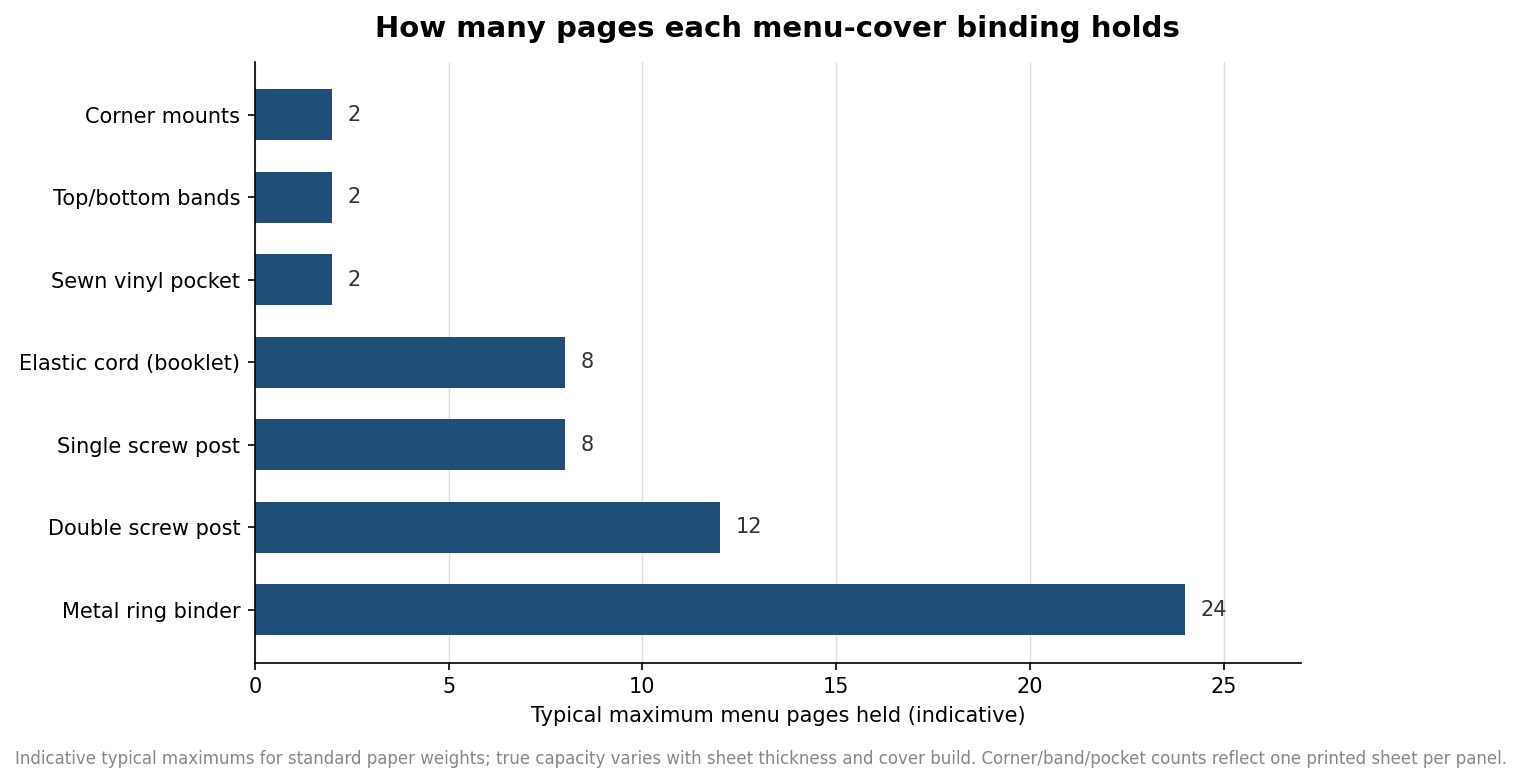
Read it as a shortlist, not a scoreboard. A method that tops out at two pages is not worse than one that holds twenty-four; it is simply built for a different menu. The goal is to land on the smallest, simplest binding that comfortably fits your real page count with a little room to grow.
Fixed-sheet methods: corners, bands, and sewn pockets
Corner mounts are the classic four catch corners that grip a single printed sheet on each panel. They keep the most content visible because nothing crosses the middle of the page, and a server changes the menu by sliding the old sheet out and the new one in. They suit single- or double-panel menus that change on a print cycle rather than daily, and they are the least fussy option to load. Their limit is that each panel holds exactly one sheet, so a corner-mount cover is not the way to carry a multi-page list.
Top-and-bottom bands, sometimes called strips, hold the sheet along its top and bottom edges instead of the corners. The look is a little different and the swap is just as quick, but the trade-off is the same: one sheet per panel. Bands are a reasonable pick when you want the corners of the page left clean for a logo or a border that would otherwise disappear under a catch corner.
Sewn vinyl pockets and clear sleeves slide the printed sheet into a protective pocket that is stitched to the panel. This is the method to reach for in high-spill settings — cafes, pool bars, breakfast service — because the sheet sits behind a wipeable window and survives wet hands and set-downs. Most pockets carry one or two sheets per panel, so treat them as a fixed-sheet method with armor rather than a way to add pages.
Multi-page methods: screw posts, elastic cord, and ring binders
Screw posts, often sold as Chicago screws, run two metal posts through drilled holes in the inserts to clamp a stack of pages inside the cover. You can expose the posts on the outside spine so a manager can unscrew them and reload in a minute, or hide them behind an interior flange for a cleaner look — the hidden version is what many suppliers call a captain’s book. Indicatively, a single post carries up to about eight sheets and a double post around a dozen, which makes screw posts the workhorse for menus that grow a page or two over a season. The catch is that reloading takes a screwdriver or a coin, so this is a periodic-reprint tool, not a daily one.
Elastic cord and string retainers hold a folded booklet in place with a cord whose barbed ends push into eyelets on the spine, or with a loop that wraps the spine. A single eyelet holds a modest booklet and a double eyelet steadies a thicker one, and because there is no hardware to unscrew, a host can change the whole booklet in seconds. That makes cord binding the natural choice for lists you reprint often, such as a daily specials booklet or a rotating cocktail menu.
Metal ring binders rivet two or three rings to the spine so pages turn like a small book. They comfortably carry fifteen to twenty pages or more, which is why they show up on deep wine programs and page-turning drink books where guests expect to browse. The trade-off is bulk and a more utilitarian feel, so most operators reserve rings for the back-of-house-heavy lists rather than the a la carte menu on every table.
Matching the binding to your insert size and paper
Binding choice is not only about page count; the size and weight of the sheet matter just as much. A small, light a la carte strip sits happily in corners, while a tall, heavy tabloid sheet sags and pulls out of corners over a shift and wants the positive grip of posts or rings. The scatter below plots the standard US menu-insert sizes so you can see where your sheet lands: the larger, heavier formats toward the upper right generally pair better with screw posts or ring binders than with corners or bands.
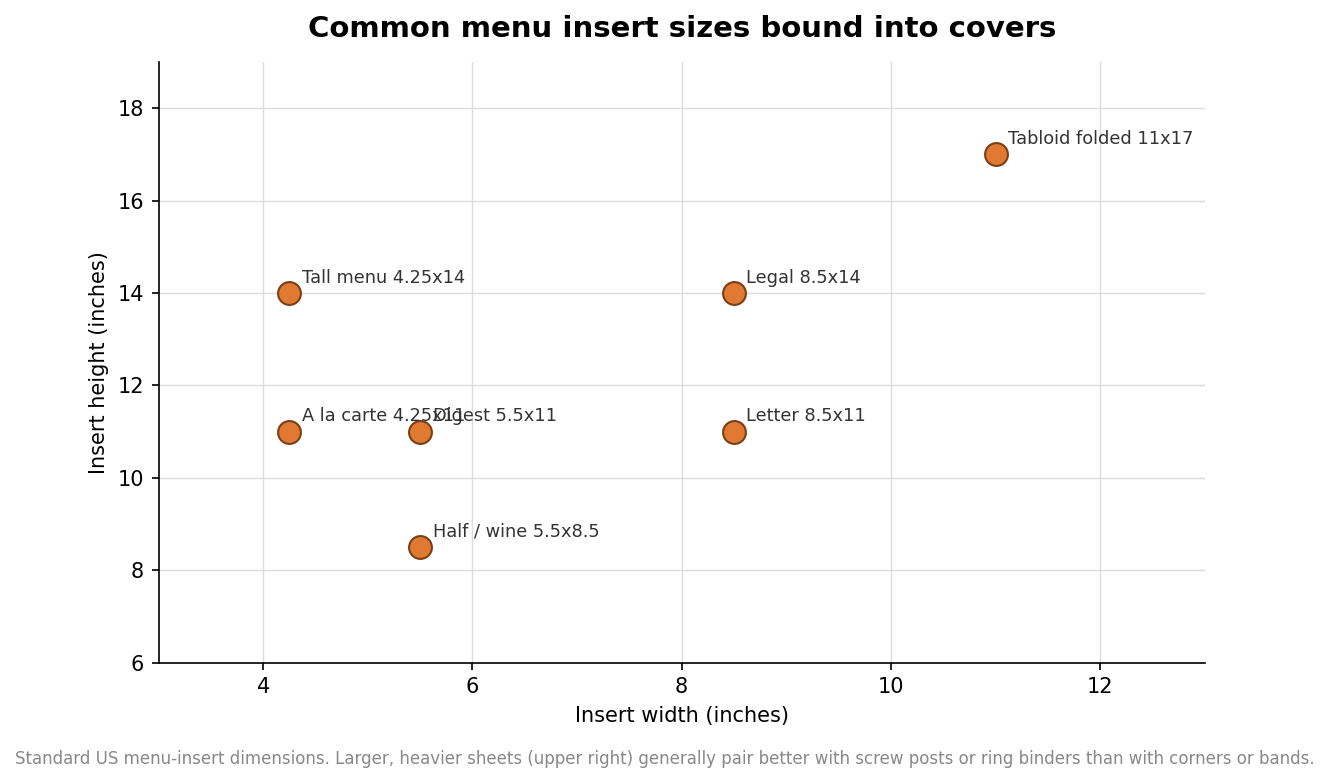
Paper weight closes the loop. A crisp 80 to 100 lb text sheet loads easily into corners and pockets, while heavier cover stocks and laminated inserts hold up longer but add thickness that eats into a screw post’s page ceiling. If you need both durability and several pages, a coil-bound insert — a small booklet that is itself bound and then held by a pocket or cord — is usually the most durable way to keep multiple pages together without stressing the cover.
How to write the spec so the sample matches the reorder
The single most useful habit is to describe the binding by function, not just by a vendor’s style name. Style names differ from one supplier to the next, so a spec that says only “plaza style” can produce two different covers from two shops. State the insert size and orientation, the number of reading surfaces you need, the fastener type and count, whether the hardware is exposed for easy reloading or hidden for looks, and how a server is meant to swap the pages. Those five details remove almost all of the ambiguity.
Then ask for a production sample loaded with your actual paper rather than a blank display cover. Loading your real sheet is the only reliable way to confirm that the corners hold it flat, the posts clear the margin, or the cord tension is right. Custom leather and bonded-leather covers are commonly sold in modest minimums — often a few dozen units — and with Custom Leather Menu Covers standard production ships in about 2 weeks once artwork is approved; faster turnaround is available with express shipping. Confirm minimums on a written quote. Get the binding right on the sample and every reorder after it drops onto the table exactly the way the first one did.